Thursday, May 3, 2012

The Journey Towards Cloud Consciousness

There will come a day when iPhone level tech become so pervasive that every child will be given a device upon birth. The device will then track the child's educational growth and adapt in both programming and hardware to match the child's maturity level. The data that the device records will follow the child into adulthood, acting as a lifetime resume, giving employers metrics regarding the individuals learning curve that will influence the hiring process.

The device will follow the individual into old age, acting as a companion and a caretaker, tracking things as common as an inventory of paper towels or toilet paper and automatically reordering before the individual runs out, to as specialized as mental and physical acuity, scheduling trips to the doctor when necessary.  Eventually, the device will act as the AI necessary to keep the individual's consciousness alive by transmitting all the knowledge the individual collected as well as patterns of curiousity and creativity based on algorithms into the ethereal web, forming a Cloud Consciousness, and allowing the next generation of DaVinci and Einstein to collaborate with the living over the course of centuries.

Toys like this are only the first step towards that future, and it will be beautiful. :)

Sunday, April 29, 2012

8 Bit Bonanza


Yesterday, I crafted a font called 8BitBonanza. The font is based on memories of old videogames, specifically the hand-held variety. Feel free to download and use it for whatever you like. If you do something cool with it, let me know in the comments!

Enjoy!


Saturday, April 21, 2012

Project Glass and Three Visions for the Future of Art


Back in 2003, I wrote a story involving a pair of glasses called ASpects, or Augmented Spectacles. It was a silly name, containing the anachronistic duality of a conceptual item. Having to wear glasses myself, the idea of turning my physical hindrance into a technological advantage had been a dream since being introduced to Geordi LaForge. Now, in 2012, Google introduces Project: Glass. For some, it sounds like hi-sci-fi, with the harshest critics claiming vaporware. For hopeful futurists, it is like being told Santa Claus is real and is bringing you cyborg vision.


Google itself has done a fantastic job describing some of the prospective everyday uses for the technology, but what about more specific applications? Certainly it will bring a new level of discourse to business, providing stock traders with up-to-the-second tickers available right within their field of vision. Should a sports model be available, it would surely be outlawed on the professional field of play, as applications could theoretically be developed that would allow batters to determine the speed of a pitch, and providing them signals regarding whether to swing or not. What applications could the art world develop for use of this prospective new technology?

I propose three options. Not the last word in any sense, but examples of possible uses:

1 - Use in Development

Painting a canvas is messy, especially when you lack a steady hand. Even an artist with dedicated focus can pull back and find they have added an arc instead of a line to the portrait. An obvious option involves the use of a straight edge to guide the brush, but then we run back into the dilemma of mess. Projecting a line or shape onto the canvas is another option, but then you still have to factor in shadows.

With AR glasses, an artist could establish some of the more difficult lines and arcs and synch a virtual screen over the breadth of the canvas, giving the artist a guide to follow that doesn’t smudge the paint or place the artist in uncomfortable positions while trying to keep out of the light.

Hanging the piece would also become simpler, as an onscreen level would show how far left or right you need to nudge the piece to be parallel to the ground. 


2 - Use in Media

What will be most interesting is the use of AR glasses as a medium itself. The lines between traditional and digital media will blur to the point of indistinguishable from one another as artists begin coding their canvas to synch with what the viewer sees. A landscape painting will suddenly become a haven for a pre-programmed imaginary friend living in the Cloud.


Portrait without AR Glasses
Portrait with AR Glasses

3 - Use in Collection


You’re seated in a coffee shop, reading a magazine, when you view one of the most gorgeous sculptures you have ever seen. The AR glasses scan the tag that accompanies the image and discovers that the piece is being exhibited at a gallery across the city, is for sale, and has received five-star ranking from countless critics within the city. With the bat of an eye, you have purchased the piece remotely and are given directions to the gallery so you may pick it up in person, as well as browse what else they may have in their collection that is similar to the sculpture.

As I mentioned before, there are countless other possibilities, and I’m sure we won’t even uncover a small sampling of them until the glasses are available and within the hands of the public. What other uses can you envision for AR glasses in the art world?

Saturday, April 7, 2012

The Show Must Go On and On and On...

Narcissus and the Golden Man

"That is, an artist who creates lots of work probably experiences
prolific days and slower days." - Buffy Sainte-Marie

Despite my resolve to remain patient, February and March became a sort of time trial. During the course of the past two months, I found that I could produce a show from start to finish in an incredibly constrained amount of time. Though I have never been one to procrastinate, I have always felt that I work best under pressure, and thus have produced ten pieces of the best art of my career all in the span of 20 days.


Stories 01, or Red
The reason for my artistic surge was the Altered Esthetics Solo Exhibition Program. The program is meant to assist new and emerging artists in launching their careers. Back in August, when I first heard about the program, I was searching for a challenge that I could utilize to up-the-ante of my creative talent, having felt that I was growing complacent. So, I chose to apply. Part of the process included a proposal of the type of show you would like to produce. Feeling overly ambitious, I crafted a carefully worded proposal about creating a show within a show, about art from art. Being selected for the program, I was fortunate enough to be given the opportunity to implement my proposal to much success.

The show ran from March 2nd - 29th at the Spring Street Tavern in Minneapolis, Minn., with a reception held on March 10th. Altered Esthetics even wrote a nice blog post about the show. The show itself consisted of images from two individual series of images; Stories and Between the Lines.

Stories was a series of six images inspired by fairy tales that had hidden within them the essence of all great stories, thus telling a story in itself.


Original thumbnail for Between the Lines 02
Between the Lines was a continuation of the idea behind Stories, but with a different theme. BtL was at its core a purer representation of the original proposition that was submitted to the program. At its base, BtL was ten images that could stand alone as individual pieces of artwork. As a collection, it told the story of an artist's journey. Finally, hidden within the pieces themselves, much like Stories, were keywords that, when combined, spelled out the overall theme for the show itself.

Overwhelmingly, comments about the show and reception have been absolutely positive. I am incredibly grateful to have such supportive friends and family, as without them, the pieces would not have been as strong, and the show would not have been the success it was.

For those of you who missed the show, yet would still like to see it, there is hope. I am making arrangements to produce an extended version of the show in the form of a viewbook. Details are still amorphous at the moment, so keep an eye on this blog, as I will inform you of its completion as soon as it is ready.

In case you are impatient, have a look at Stories, and see if you can solve the puzzle:

Monday, January 2, 2012

New Year and Next Steps


As the Steve Miller Band was kind enough to teach us, time keeps on slipping into the future. In the past, I have meditated on the concept of time, its existence as a unit of measure, and how it has become an omnipresent entity while doing my best to stretch and compress this dimension to fit my personal needs. From where I currently sit, I can count eight different clocks within my line of sight, each set at a different time due to careful ignorance or the toil beset upon them by their immortal ward.

Recently, there has been a cartoon circulating that displays a Mayan showing off his calendar wheel, expressing concern to his fellow Mayan that it ends in 2012, to which the craftsman replies "that's really going to freak somebody out some day." Though I understand the humor in the second Mayan's statement, I am more intrigued by the calendar craftsman himself, and the calendar he displays. Yes, it expires in 2012, but it is still useful for thousands of years. Though our tools and measures and calendars may expire, time always marches on. So why measure at all? Why not just live in an endless cycle of sleeping when tired and waking when not, regardless of the sun's position in the sky? It's not a new notion that setting our schedule by the setting of the sun is rather antiquated, especially with the growth of 24 hour conveniences. Da Vinci is said to have slept in 20 minutes spurts every four hours, a technique that added hours to his work day, yet would be heavily frowned upon in the modern workplace. Or maybe this isn't a matter of keeping to cycle, but rather keeping sane?

Einstein defined insanity as doing the same thing over and over again and expecting different results. By keeping a cycle, and noting specific beginnings and ends, one has set aside points at which to assess their actions and determine whether changes need be made, even if the changes only fortify the plans one had previously been pursuing. Hence, resolutions.

Woody Guthrie wrote a list of resolutions that are familiar without being common or restrictive. For me, I like to keep my list short and sweet, as it is easier to remember and accomplish:

slow down, plan ahead, proceed with confidence.

Though it may seem small, it actually cuts a wide swath in the actions of my life. If you want something more detail oriented, I present you with the following list: 

1) Read/Write/Draw more -

Over the past couple years, I have grown complacent when reading, and have developed a form of speed-reading that encourages quick sprints across the body of a text in favor of the deep diving necessary to keep information. It is not a bad thing, as it has developed a sense of thin-slicing, but it has limited the amount of information I gather from any source and has made it more difficult to make it through long pieces of narrative. This growing tendency toward thin-slicing has also had similar effects on my writing and art. Slowing down will grant me the time necessary to re-engage literature, art and life, and hopefully reduce the number of unread books on my bookshelf drastically while simultaneously increasing productivity and communicativeness.

2) Reduce overhead -


Like many, I have fallen into routines that waste time, money, and resources in general. By planning ahead, it is my hope to cut out many of these habits so as to live a simpler, more care-free life over the course of the next year.

3) Eliminate "I am horrible/fantastic" - 

Recently, I came across a piece of advice that boils down to "I am horrible/fantastic: Don't think either." I have a habit of leaning towards the horrible spectrum in most of what I do, despite occasional evidence to the contrary. Whether it is in art, writing, or life in general, the idea of proceeding with confidence falls within the golden mean, or walking a path between vice and virtue, to allow for maximum happiness.

So there it is. My resolutions for 2012. What are yours?

However beautiful the strategy, you should occasionally look at the results.
- Winston Churchill
In other news, the start of 2012 also heralds a transition into the second five year period of my 15 year plan. Of course, this brings with it good news and bad news.


The good news: I met all the goals I made for myself in the first five years.

The bad news: I just barely made my mark.*

Considering the bad news isn't so bad, I see no necessarily reason to redress the first five years any further aside from using the lessons learned to head into the next five years with even greater confidence and courage.

With that, I wish you all a fantastic new year, and the best of all that can come from it!

---

*As I wrote this, I realized though the pun was not intended, it was still quite apt.

Sunday, September 18, 2011

3 More Lessons - The Wonders of Penny Arcade

NOTE - Over a year ago, I wrote a number of posts regarding my Top 10 Influences. Consider this to be the unofficial #11.

Penny Arcade, by Mike Krahulik
October 23, 2008
In 1998, Messrs. Jerry Holkins and Mike Krahulik debuted what has become the most successful webcomic to date. This is not hyperbole or opinion. This is fact. They have taken what had started as secondary content for an already established site and have turned into a cultural zeitgeist amongst a land of memes. One could say Penny Arcade did for the internet what The Simpsons did for television, but they would be wrong, if only for their lack of scope.


I could go on and on, about how they branched out into books, games (both digital and analog), conventions, a television network (does it still qualify as television if it is exclusive to the web?) and a full-blown charity that is so incredibly noble that it can actually rekindle a person's hope in humanity. Did you know they actually have their own line of clothing as well? I don't mean t-shirts here either. I mean an actual clothing line that is aimed at a specific market demographic.


Like I said, I could speak at length about the incredible kingdom they have created. However, that has already been touched upon in so many other forms, that it is pointless for me to retread on that ground. Furthermore, if you are reading this, then there is a good chance that you have taken more than one road-trip down the information superhighway, and have inevitably heard some mention of Penny Arcade. Instead, I want to talk about what Penny Arcade has done for the comics medium and what it has taught me.


ANOTHER NOTE - Before I continue, I want to establish some shorthand. From hence forth, Tycho shall refer to Mr. Holkins, Gabe shall refer to Mr. Krahulik, VG will be shorthand for video games, and PA will refer to the overall entity of Penny Arcade.


1 - Patience and persistence pays off, but don't be afraid to experiment

Lookouts, by Mike Krahulik - January 15th, 2010

Art does not sprout fully formed from the artist's head like a Grecian goddess, nor are artists born with an inherent talent or style. Everything that an artist produces that is aesthetically beautiful takes time and effort. Gabe is no exception.

If you take just a quick glance at the PA daily strip, and you may take for granted the time and effort that goes into it. It's not the hours of time Gabe spends drawing each strip, but rather the years of dedication that show up in every panel. The current look of the average PA strip took years to chisel out of nothing.

The original Lookouts strip
from June 10th, 2009
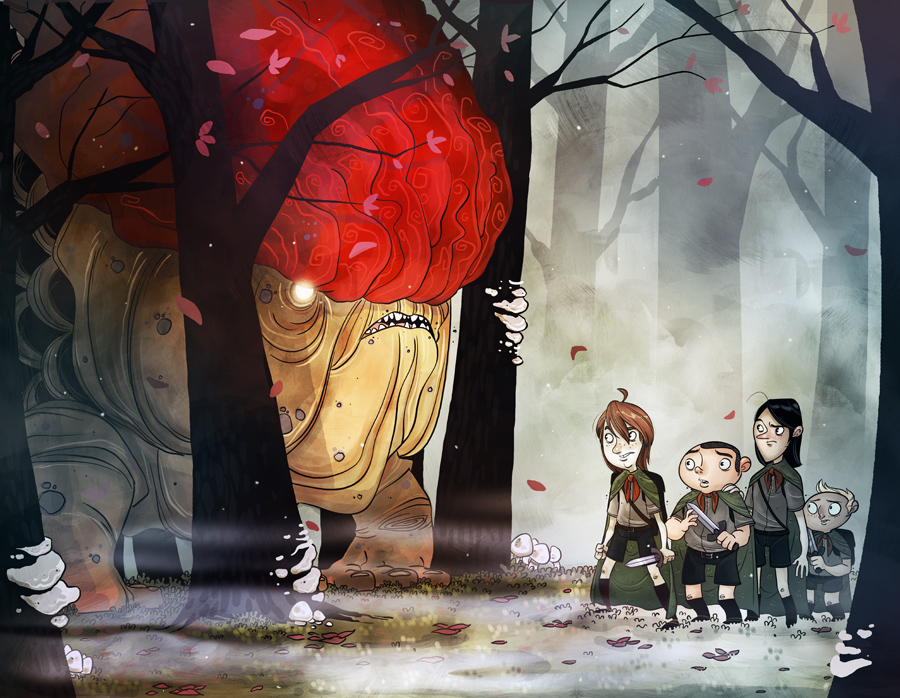
Even more impressive than Gabe's daily work are the occasional strolls down long-form narrative and solo pieces. In these, Gabe displays a keen eye that knows when to add and when to subtract detail. One of the most striking of these instances comes from the original Lookouts story from June 10th of 2009. In it, Gabe escapes the trappings of conventional, animated realism to exhibit a more etherial, impressionistic take on the background. With the loss of any solid backgrounds, swirling colors and strategically placed lines take the place of a definite setting, allowing for a world of simultaneous whimsy and worry.

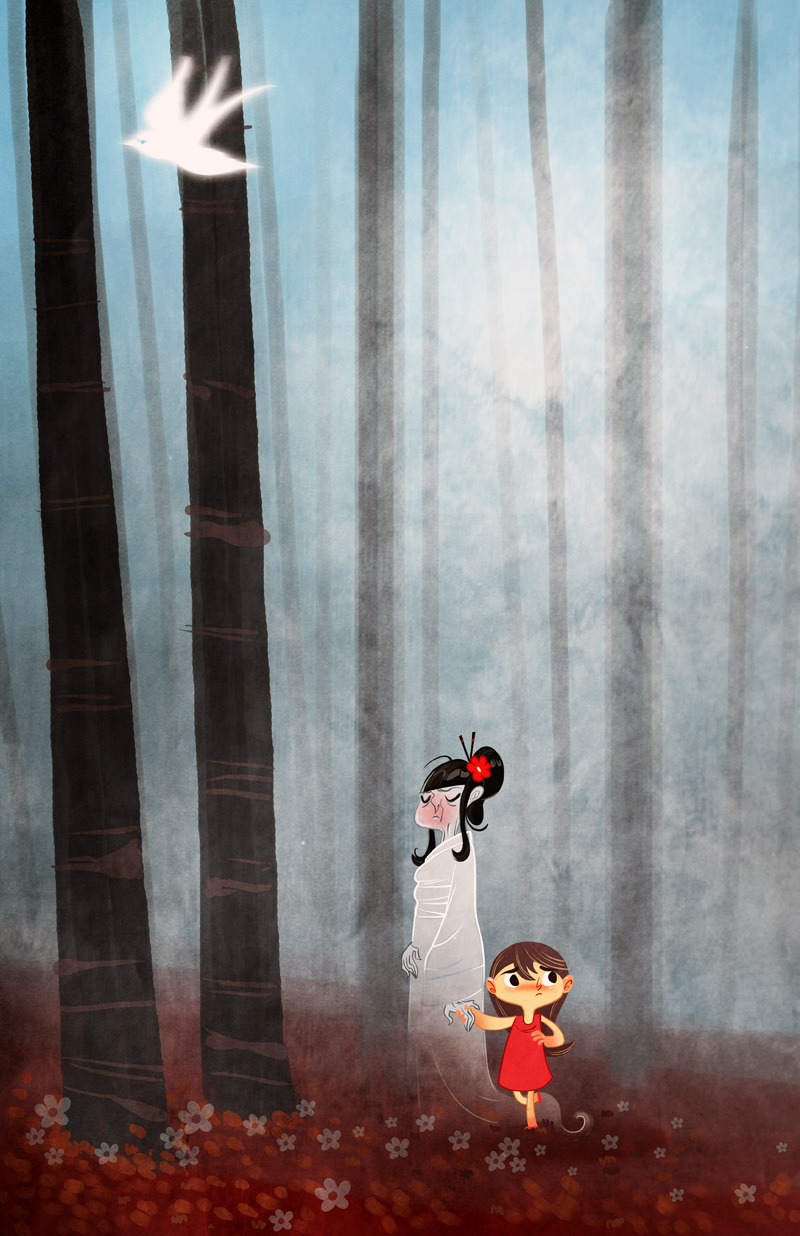
The Girl and the Ghost, by Mike Krahulik
November 19th, 2009
These same traits can be found in an earlier piece called The Girl and the Ghost, from November 19th, 2008. In it, the same impression of a world found in The Lookouts is displayed in a more haunting fashion.

About a six months after the debut of the Lookouts, Gabe returns to the fertile forest playground with a solo piece that could easily be a fusion of the original strip and The Girl and the Ghost.


To often, artists can drown in the boredom of their style. Though some critics may balk  at an artist's shift, it is necessary for any creative person to breath and experiment, if for no other reason than to improve upon what they already produce. In the case of PA, I am thankful that Gabe takes the time to produce solo work, because without it, the adventurous, long-form jaunts, such as Lookouts and Automata, may not exist; and though I may wish to see more long-form narrative from Tycho and Gabe, I am more than happy to take what they provide over having nothing at all.
Automata, from
June 12, 2009

2 - Creating comics can be applied to the greater good


Growing up, I loved comics. The art, the action, the writing - I loved every aspect of the medium. What I loved most were the morality lessons that were found within the pages of X-Men and Avengers. X-Men taught me that people are people, and you shouldn't discriminate based on their differences. Avengers taught me that you must stand up for what you  believe is right, even if the opposition is bigger or more powerful. In essence, comics made me want to make a better world so much that I took the following, self-written oath, and still stand by it to this day: I SWEAR BY MY LIFE to change this world for the better!

In 2003, PA created Child's Play as a response to the fallacy of VG's influencing youth towards violent behavior, and I had just started college. Through intense study of writing and art, I had decided that comics were the alpha and omega of broadcasting ideas from one human to another. I was so convinced by this fact that it became the central thesis of my entire college education. By my senior year, with months left before graduation, I was infected by the same idealism that hits most college students earlier in their student career. I remembered my oath, and realized that I had been training myself all wrong. Imagine if Batman vowed to avenge the death of his parents by waging war on crime, and then four years later winds up with an art degree and no idea how to fulfill his goals because he was distracted by the shimmering allure of comics. To exacerbate an already embarrassing situation, I had just received a rejection letter from the internship I had foolishly banked the entirety of my future plans on. With graduation fast approaching, I had no idea what I was going to do after school. Instead of devising any concrete plans, I sat in my Computer Science class and gorged on PA.

Whether I had forgotten, never known, or just hadn't put the pieces together, PA had already created the solution to my problem. They had leveraged their success into actual charity. They weren't just giving money for others find solutions. They were giving money, raising money, and making the solutions themselves. In the case of Child's Play, they were raising money to purchase VG's and toys for the children's wards at hospitals to make what is a genuinely frightening play a little less scary for kids who had to be there.

By themselves, comics may not be able to cure diseases or stop wars. They can make the world a little less frightening through their own accord, but if used wisely, they can assist in collecting the resources necessary in stopping social ills and direct them towards the organizations that can.


3 - The future is nothing if not an echo of the past


One of the oft-overlooked cornerstones of PA is the commentary by PA co-creator Tycho. A person who has only read the comics themselves can be forgiven if they view PA as nothing but a series of dick-and-fart-and-VG jokes that can appeal to the masses. Inexcusable are critics who judge PA based on the jokes alone. To do so would be akin to calling Shakespeare or Mozart hacks because you believe the entirety of their work revolves around basal humor.


Tycho is a writer of immeasurable talent who is able to connect with the audience. Like Shakespeare or Dickens, he weaves the narrative of everyday life together with what the audience wants, with what the audience relates to. In fact, much like Dickens, Tycho is able to produce profusely on the perfunctory and still make you care. His interests aren't solely based in and around VG culture, but transcends the black hole of mass media and steeps itself in everything from Milton to Dungeons and Dragons.


What is a writer if his work doesn't resonate with the audience? The short answer is obsolete, but in reality, would they be a writer at all? Like all the writers of the past, Tycho could write to satisfy critics, but doesn't, because the critics aren't the target. He just writes like others breath. He, like Dickens, is the voice of the public; his words are a tapestry of the era.

Saturday, April 9, 2011

Paracosm, Brikabrak, Cerebus and Mini-Comics


I just woke up from a nap. It was one of those naps where there was no actual sleep, and my eyes only stayed close if I concentrated on them doing so. Really, it was just a brief period of complete and total inaction. No thought, no movement. Much like watching TV, but without the painful numbness that accompanies prolonged exposure.

When I returned to general consciousness, I was filled with an overwhelming sense of dread. A harbinger of doom was sitting in the corner, making snide commentary. After checking all the usual sources, it was finally concluded that the harbinger was just having fun at my expense.

***

I'm closing in on finishing the first chapter of my new project, Paracosm. If there was anything for me to be excited/anxious/ecstatic/concerned about, it would be this. However, instead of taking any real pause to consider what its completion might create, I am more interested in writing the next few chapters. Especially since the conceptual format of the project is so fluid. Paracosm - Chapter 1 is a pale shade of what it was upon conception. Overall, Paracosm has a loose sense of where it should go, akin to the directions of Horace Greeley: "Go west, young man."

Move forward. The only direction I have for this project. Years of planning and practicing and preparing have ultimately left me with nothing but drive. Cast aside are any concerns regarding quality. Instead, I'm doing a project that is solely for my own interests. Most of the work that has gone into this project is just a method of chaining down a fleeing sanity disgusted with the environment it has been left to deal with.

***

The picture above reminds me of an extremely short story I wrote possibly a year ago. If you will permit, I would like to share it with you:

Where the Ideas Come From

Underneath my bed, there is a small troll named Brikabrak. He is not a troll like the ones of legend, known for eating children and other horrible things. Nor is he one of whimsical fancy, associated with granting wishes and being generally delightful. Brikabrak is, for the most part, just an ordinary troll. However, at night, when I lay my head to sleep, Brikabrak climbs out from under my bed, and whispers stories in my ear as I dream. Sometimes they are old stories, like how the tortoise got his shell. Some stories have yet to occur, such as the story of Zeta, the first child born of the singularity. But he tells stories. New stories, every night, only ever repeating himself to suit my own preferences. And as such, I have yet to banish him from under my bed. For as long as he keeps telling stories, he shall always have a place in my room.

***

I've started reading Cerebus. I'm starting with Volume 13. It is good. That is all I'll say about that.
 
***
 
April 9th is Mini-Comics Day. I may do something to celebrate. I'll let you know if anything develops. I encourage you all to try something as well. Even if it is as simple as folding a piece of paper twice and scribbling on the sub-pages, there is something uniquely fulfilling about creating something that you cannot understand until you do it yourself. The more I think about it, the more likely I am going to create some sort of 8-page monstrosity for the sake of creation. For now, I think I will end this one-sided discourse with the web in favor of meandering whatever ethereal pathways I can find between now and slumber.

Peace and Love, my very special friends!